Rega Aria MK3 review

Rega Aria MK3 review

rega hifi logo Aria MK3 – £899

The latest iteration of the Aria from a name that’s synonymous with fine phono stages


What’s the difference between the Aria MK2 and the l\1K3? Well, you’re looking at it. On the inside, nothing. On the outside, what Rega calls its “latest half-width, custom-designed case to give the Aria a fresh new look”. Very smart it is, too, in a Planar 10 turntable PSU-matching kind of way.

Not that the inside was in any need of updating – according to Rega – its celebrated expertise in phono stage engineering should be enough to send a shiver of trepidation down the spines of the opposition. As with the others here, this is an all-analogue MM/MC affair, eschewing the modernity of something like Chord Electronics Huei for old-school mechanical load switching.

Configured via six DIP switches on the back, the choice of impedance loading runs from 70 to 400ohm and capacitance from 1,000 to 4,200pF. Input sensitivity can be changed by 6dB, again by DIP switches.

The MM input uses low-noise, bipolar transistors configured as a compound pair, while the MC input employs parallel-connected, low noise field-effect transistors to avoid bias current flowing in the cartridge and interfering with the cartridge’s magnetic geometry. Both stages have separate input sockets and circuitry and signal switching is performed at high level and low impedance to ensure no degradation of the signal.

In the same vein, a self-adjusting servo control keeps the MC input circuit at its optimum, compensating for any variations in ambient or operating temperature. High-quality polypropylene capacitors are used in the signal path and equalisation networks and discrete circuitry are used throughout the signal path, allowing Rega full control of the circuit design.

Sound quality

The Aria is competing against some seriously talented kit in this group, yet it still manages to sound uniquely ‘Rega’, despite taking its lead from a turntable and cartridge a little less conscientiously resolute than one of the company’s own. It isn’t all about the amount of information that it shunts from the cartridge to the amplifier, however. In this respect, it’s very much operating in the same ballpark as the Lehmann and Tom Evans. It’s more a question of what it does with it. And here the fine detail is kept firmly in a musical context. The small stuff is present and heard but the Aria doesn’t sweat it, much less shine a spotlight on it. Tie loosened off, shirt sleeves rolled up, it’s more concerned with sounding honest and authentic and that has a lot to do with rhythm and flow.

There’s a very appealing loose­limbed suppleness to the Aria’s work that chimes well with the Pro-Ject turntable’s approach. It’s exactly the kind of sound that makes disaffected digital devotees want to buy a decent turntable. As such, the Rega draws plenty of colour and emotion from the duetting voices of Thorn and Watt singing the chorus of We Walk The Same Line. Marcus Miller’s bass guitar doing the heavy lifting on Que Sera Sera seems to have a raised funk quotient on top of being just as super-taut and articulate as you’d expect. As for Curtis Fuller’s skilful but rather under-inflated trombone solo on Blue Train’s Locomotion
(unfortunately sandwiched between a consummate Coltrane and dazzling Morgan), what typically comes across as lacklustre and washed out, even on CD, is at least given the kiss oflife by the Aria and pulled closer to the performance zone occupied by his fellow musicians. The Rega has the happy knack of loving the music.


Connections:

  1. MM stereo RCA inputs.
  2. MC loading and gain DIP switches.
  3. Stereo RCA outputs.
  4. MC stereo RCA inputs.


HiFi Choice Verdict:

SOUND QUALITY: ⭐️⭐️⭐️⭐️⭐️

VALUE FOR MONEY: ⭐️⭐️⭐️⭐️⭐️

BUILD QUALITY: ⭐️⭐️⭐️⭐️⭐️

FEATURES: ⭐️⭐️⭐️⭐️ and 1/2.

Overall: ⭐️⭐️⭐️⭐️⭐️


Audience Hifi 
Find us: 14 Broad Street, Bath, BA1 5LJ
Tel: 01225 333310
Email: info@audience.org.uk

All credit to: HiFi Choice

Majik DSM

The Majik DSM has received a complete makeover for 2020.

The Majik DSM has remained a firm favourite since its launch in 2012, securing its place as the best-selling Linn network music player of the last decade. It has received a complete makeover for 2020. It has an incredible new level of performance, new features and a fresh new look. The Majik DSM truly is an ideal hub for the living room, and a neat way of expanding Linn sound throughout the home. It contains all the analogue, digital and wireless connectivity you need to connect all your sources, from TV to turntable, to make everything you listen to sound better. As we continue to spend more time at home than ever, the Majik DSM’s transformation is even more attractive.


Audience Hifi 
Find us: 14 Broad Street, Bath, BA1 5LJ
Tel: 01225 333310
Email: info@audience.org.uk

Rega Io integrated amplifier review.

A review from theEar. (Rega Io integrated amplifier review.)


At the Bristol Show where the notion of a 2m social distance was totally unheard of Rega showed a complete vinyl replay system with a price of just £1,000. Now that might not seem all that impressive in the general scheme of things but when you consider that it is built entirely in the UK and comes from a company with a very good reputation, the full awesomeness of the deal is more obvious. The system consists of a Planar 1 turntable, the new Io integrated amplifier and the not yet in production Kyte loudspeaker, the latter being the most radical element with its phenolic resin cabinet. But the Io at £379 is a remarkable achievement for a British company given that the previous entry-level amp, Brio, is £599.


The Io is a diminutive thing, smaller than a Cyrus and yet it has all that you need to build a system around it, a 30W class A/B amplifier, MM phono stage for the turntable and two line inputs for any other sources you want to add. There is even a minijack headphone socket on the front and full remote control.


io-rear-panel-closeup-offside.jpg


As well as being the smallest Rega amplifier it’s also the first one designed by Ashton Wagner who based the Io on the Brio but had to make changes apart from the casework to bring the price down. He said that the real differences are the power supply which is closer to that in the Brio-R, more affordable op-amps and a simpler power transformer without isolated windings, plus of course the reduction in inputs. In his words: “We really wanted to focus on giving the maximum sonic punch at the price point, which informed our decisions about what to keep in and what to leave out. A lot of the cost savings came from running the amp at a lower power level, which allowed us to use a smaller, simpler case. We also put a lot of work into figuring out how to streamline the assembly process via the design of the product”.


So it really is as simple and straightforward an amp as Rega can build but it doesn’t cut corners when it comes to the parts that count. The front panel controls for input selection and volume are plastic as is the surround on the fascia but the box itself is solid and nicely constructed and the inputs and terminals on the back are of a decent quality. Given that most operation will be with the remote handset the limited tactility of the on amp controls is not a big issue. The remote does pretty much everything including control other components such as Rega CD players, and with only three inputs one of which is phono it’s also easy to find the source you require.


io-amp-onside.jpg


Sound quality.
theEar started off by putting the Io in a system that approximates to the budget one that Rega had in Bristol, with a P2 turntable and RX3 loudspeakers on a standard rack with basic power cables and only slightly OTT Townshend Isolda speaker cable. No isolation products were used but neither were spikes, so a real world entry level system, or as near as they could rustle up. It proved very entertaining, delivering tight solid grooves, decent power and good vocal clarity, on Yussef Kamaal’s Black Focus the kick drum had plenty of impact and the snare had decent snap. Overall the Io delivers plenty of drive with control, this was made clear on the percussive electronica of Floating Points’ Les Alpx where the power and dynamics of the big blips and bumps that kick it off were good and chewy, more importantly it sounded like music and not a series of synth and sample notes, which is not always the case with this track. The bass line of Funkadelic’s Music for my Mother was thick and heavy, just the way they made it and the system delivered the essence of the track in full effect, its analogue origins being perfectly clear. It has a directness and detail level that is frankly surprising given the modest nature of the system, but all Rega systems tend to do this.


Sarathay Korwar’s Bol from last year’s More Arriving album sounds much more up to date, it’s clean and the vocals project well but there’s a hardness to it that is less appealing, this is partly because a lot of detail is compressed into a small dynamic space but also because of the digital nature of that compression. The Funkadelic is no less limited but it sounds warmer and smoother. They tried a very different record in Beggars Banquet by the Rolling Stones, this has some heavy cultural appropriation on Prodigal Son where Jagger does his best aged bluesman wail to great effect over acoustic guitar and drums. Things are much more interesting on the raw Stray Cat Blues where the guitar playing cuts through the compression and gets to the quick. It reminds you that this band never quite matched its Brian Jones era and that whenever they start playing great records on a Rega they forget about sound quality and get distracted by the music. But this is because that’s what comes first, whatever limitations of foibles the system has do not intrude on the performance on the recording.


io-PCB-side.jpg


They also put the Io into the ‘big’ system with full equipment isolation, decent power leads and serious signal cables. Here they paired it with the PMC twenty5.22i bookshelf speakers reviewed recently and, just for the fun of it, a Rega P10/Aphelion 2 turntable with Tom Evan’s Groove+ SRX phono stage. And you know what, it was great. It drove the PMCs remarkably well and produced some delightful music, not least Tom Waits’ Rain Dogs (check out the Waits documentary on iPlayer) which had them dancing around the room like a loon. It’s inevitably not as revealing as the bigger amps generally found in this system but what it lacks in transparency it makes up for in timing and musical coherence. They also put on Alfred Brendel playing Haydn and the spirited style of playing was made very clear indeed, it could have been smoother perhaps but this is why you don’t put budget amps with high resolution speakers, it’s unbalanced but very enjoyable nonetheless.


io-amp-offside-low.jpg


The final pairing went the opposite way on the speaker front, they pulled out a pair of Q Acoustics 3010 budget bookshelfs, one of the least expensive decent speakers you can buy. This combo proved crude but entertaining with decent bass for the box size and imaging that could have come from a rather more pricey pairing. They played a live version of Zappa’s Sharleena, the one where Frank’s son Dweezil gets to let rip. It sounded good enough to make it clear why his siblings Moon Unit and Ahmet decided to make Dweezil’s life difficult after both parents had died. Valley Girl was exploitation, Sharleena is self expression live on stage with the master.


The Rega Io is a great little amplifier, it packs a punch that you don’t get from the far more highly featured competition that exists on the market and delivers music that you just want to keep playing. It will be intriguing to hear how it works with the Kyte speakers when they come through but in the meantime we have a British amplifier that most music loving Brits can afford.


SPECIFICATIONS: 

Type: Integrated amplifier
Analogue inputs: MM phono, 2 line-level
Digital inputs: none
Analogue outputs: tape
Bluetooth: no
Input impedance: line – 47kOhms, Phono – 47kOhms, 220pF
Headphone Loads: 32 – 300 Ohms
Power Output: 30W into 8 Ohms
Dimensions (HxWxD): 68 x 180 x 290mm
Weight: 2.9kg
Warranty: lifetime


PRICE: £379.00

All credit to: Jason Kennedy & The Ear for providing this Rega Io integrated amplifier review.


MANUFACTURER DETAILS: 

Rega Research
01702 333071
www.rega.co.uk


Audience Hifi 
Find us: 14 Broad Street, Bath, BA1 5LJ
Tel: 01225 333310
Email: info@audience.org.uk

The Rega Planar 8 has been awarded best turntable £1000 & over.

The Rega Planar 8 has been awarded AV Forums Editor’s Choice for 2019 – Best turntable £1000 & over.


avforums editors choice - rega planar 8 badge

The Rega Planar 8 is an unsuspended, belt drive turntable that replaces the long running and much loved RP8. While it is possible to recognise elements of the RP8 in the design, this a turntable that doesn’t look like anything that has been done by them before. The Planar looks and feels like something from the Aerial Atom school of industrial design. The feel is important too. With so little of it in many places, it would have been an easy thing for the Rega to feel lightweight and insubstantial but it really doesn’t. You can buy bigger and more ornate turntables for the same price but I don’t know of much that feels more solid.


With large scale music, the Planar 8 is effortlessly open and three dimensional. The sound extends out beyond the speakers but does so without leaving any sense of a hole in the space between them. The entire performance of the Planar 8 is a demonstration of what vinyl can deliver as a format once you meet the required investment. There’s no warmth or bloom to this – it’s as warm as the recording and nothing more. This is a phenomenal turntable and one that makes a justifiable claim to being state of the art at the price point and it takes AV Forums award.

“Best Turn Table £1000 and over”


rega p8 (Rega Planar 8) turn table


View the full list of awards here.

Article by: AV Forums

Get in touch with us here if you’d like more information on a Rega P8.


Audience Hifi 
Find us: 14 Broad Street, Bath, BA1 5LJ
Tel: 01225 333310
Email: info@audience.org.uk

Updated for the vinyl generation.

Below we have an article about the Nait XS3 (£2,199) and Supernait 3 (£3,499). This demonstration was performed in our showroom, in Bath!

Naim’s top integrated amplifiers have been updated for the vinyl generation. Both the Nait XS3 (£2,199) and Supernait 3 (£3,499) have had a MM phono stage added to their roster of line inputs. Naim’s Steve Sells and the R’n’D team in Salisbury have also upgraded the Supernait’s power amplifier that have resulted in a more muscular and timely sound than was possible with its predecessor.

The phono stage is based around Burr Brown op amps and through-hole rather than surface mount resistors because the performance of the latter is compromised by thermal variations. Naim has chosen polystyrene input capacitors for their low dielectric absorption and in the Supernait the entire phono stage is mounted on a separate board for isolation purposes.

Some will recall that the first two Supernaits did not have phono stages because Naim said that their performance would be compromised by the proximity of a large transformer and that having one onboard could undermine performance for the line inputs. Steve Sells explained that there is now more “desire to do it” because of demand from customers enjoying the vinyl renaissance. This has resulted in the engineers working at the problem and finding solutions, there’s nothing quite like a commercial imperative! The choice of an MM rather than MC stage comes down to the most likely users of this facility being relative beginners, better equipped vinyl enthusiasts can use the powered connections for an external Naim phono stage with MC capability.

naim integrated amplifier speaker infront of a whiteboard

For the critical preamplifier stage in the Supernait 3 Naim has taken an unusual approach to resistor choice, Steve Sells and the team decided they liked the sound of 5% resistors better than the theoretically superior 1% variety, then they selected them in-house to as to achieve a 1% tolerance from there. This is largely because Naim don’t select on specs alone but accept that certain types of distortion are worth tolerating in exchange for the timing qualities that they prioritise, essentially it’s because in their view we are more sensitive to timing errors than harmonic ones.

This approach can also be seen in the power amplifier of both models which used to have a cascode stage to protect a delicate transistor, in the new models this cascode element has been removed to make the power supply faster at the cost of a small increase in second harmonic distortion due to higher power handling second stage transistor. The new Naits continue to have Reed relay input switching with a ‘shock absorber’ capacitor and constant current supply to provide a smoother DC supply, or to use Steve’s words: “No more lumpy DC in the supply”. The headphone output remains fully class A with extra current. The input sockets are flexibly connected to the PCB on the Supernait to allow a degree of mechanical isolation, and the IEC mains input remains ‘loose’ for the same reason.

back of a naim NAIT XS 3 integrated amplifier


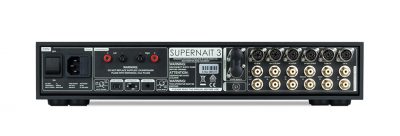
back of a naim SUPERNAIT 3 integrated amplifier

A demonstration of old versus new amplifiers via Focal Sopra No.1 speakers at Audience in Bath revealed the XS3 to have gained a distinctly more substantial bottom end with a more powerful presentation and improved timing, bringing its balance much closer to the Supernait 2. The Supernait 3 is clearly more muscular than its predecessor with stronger image depth and better timing, the latter being largely a result of the extra control in the bass.

One final snippet worth repeating is that Qobuz will become part of the Naim control app in the not too distant future. Naim hope to be making an announcement about the increasingly popular French streaming platform at the Rocky Mountain show in October but won’t give a launch date at this time. Both new Naits will be on sale at the end of July.


All credit goes to The Ear for this article: http://www.the-ear.net/features/naim-nait-xs2-supernait-3-first-impressions

Streaming Audio

It is not often there is a genuine revolution in music replay (upturn, rather than going around).

Streaming of all kinds is a liberation and a music lovers dream.

Let me explain how we see the different forms of Streaming and how the best players integrate these forms. A Streamer is simply a box just like a CD player but without the CD mechanism. The music comes from a hard drive via a broadband router rather than a CD disc. Other than that it has all the properties of a proper piece of HiFi.

Just a small techy definition at this point. Often a poor WiFi connection has nothing to do with the quality or speed of your internet connection to the outside world (WAN – wide area network). Audience can improve your WiFi within your home (LAN – local are network) but not your internet speed. Hence the first scenario below is not dependent on the speed of your connection is the outside world.

In order to control a Streamer and select music you just need an ‘app’. So your phone or tablet suddenly becomes the most wonderful remote control.

For a lot of our customers they still have an extensive CD collection. So, first things first. Let’s get those CDs ripped (recorded in non computer speak) and stored on a hard drive connected to your broadband router. Once this has been achieved then the speed of your internet connection is no longer an issue. You have complete control of the music you own and can play it through your HiFi system at will.

In addition that clever Streamer can provide access to that giant pool of music ‘The Internet’.

Let’s look at a wonderful source of worldwide music, Internet Radio. Our Streamers have this feature built in which allows you to browse radio stations from one side of the world to the other. Most of our favourites are there including the BBC and Classic FM. But there are also Reggae stations from Jamaica to jazz from Japan.

Then there is the amazing world of the online jukebox. More often referred to as ‘Spotify’ or ‘Tidal’, these subscription services offer an astounding library of music to be played as often as you like. A bit like the trend for leasing cars, in a way you just lease the music without owning it.

Add to this the extraordinary flexibility of being able to send ‘content’ (music, sound from YouTube or Netflix for example) directly from your phone or tablet to the Streamer and you have the ultimate universal player for any audio you may wish to play.