The Rega Planar 8 has been awardedAV ForumsEditor’s Choice for 2019 –Best turntable £1000 & over.
The Rega Planar 8 is an unsuspended, belt drive turntable that replaces the long running and much loved RP8. While it is possible to recognise elements of the RP8 in the design, this a turntable that doesn’t look like anything that has been done by them before. The Planar looks and feels like something from the Aerial Atom school of industrial design. The feel is important too. With so little of it in many places, it would have been an easy thing for the Rega to feel lightweight and insubstantial but it really doesn’t. You can buy bigger and more ornate turntables for the same price but I don’t know of much that feels more solid.
With large scale music, the Planar 8 is effortlessly open and three dimensional. The sound extends out beyond the speakers but does so without leaving any sense of a hole in the space between them. The entire performance of the Planar 8 is a demonstration of what vinyl can deliver as a format once you meet the required investment. There’s no warmth or bloom to this – it’s as warm as the recording and nothing more. This is a phenomenal turntable and one that makes a justifiable claim to being state of the art at the price point and it takes AV Forums award.
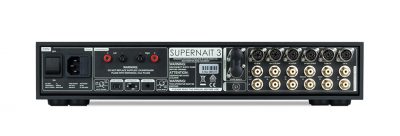
Below we have an article about the Nait XS3 (£2,199) and Supernait 3 (£3,499). This demonstration was performed in our showroom, in Bath!
Naim’s top integrated amplifiers have been updated for the vinyl generation. Both the Nait XS3 (£2,199) and Supernait 3 (£3,499) have had a MM phono stage added to their roster of line inputs. Naim’s Steve Sells and the R’n’D team in Salisbury have also upgraded the Supernait’s power amplifier that have resulted in a more muscular and timely sound than was possible with its predecessor.
The phono stage is based around Burr Brown op amps and through-hole rather than surface mount resistors because the performance of the latter is compromised by thermal variations. Naim has chosen polystyrene input capacitors for their low dielectric absorption and in the Supernait the entire phono stage is mounted on a separate board for isolation purposes.
Some will recall that the first two Supernaits did not have phono stages because Naim said that their performance would be compromised by the proximity of a large transformer and that having one onboard could undermine performance for the line inputs. Steve Sells explained that there is now more “desire to do it” because of demand from customers enjoying the vinyl renaissance. This has resulted in the engineers working at the problem and finding solutions, there’s nothing quite like a commercial imperative! The choice of an MM rather than MC stage comes down to the most likely users of this facility being relative beginners, better equipped vinyl enthusiasts can use the powered connections for an external Naim phono stage with MC capability.
For the critical preamplifier stage in the Supernait 3 Naim has taken an unusual approach to resistor choice, Steve Sells and the team decided they liked the sound of 5% resistors better than the theoretically superior 1% variety, then they selected them in-house to as to achieve a 1% tolerance from there. This is largely because Naim don’t select on specs alone but accept that certain types of distortion are worth tolerating in exchange for the timing qualities that they prioritise, essentially it’s because in their view we are more sensitive to timing errors than harmonic ones.
This approach can also be seen in the power amplifier of both models which used to have a cascode stage to protect a delicate transistor, in the new models this cascode element has been removed to make the power supply faster at the cost of a small increase in second harmonic distortion due to higher power handling second stage transistor. The new Naits continue to have Reed relay input switching with a ‘shock absorber’ capacitor and constant current supply to provide a smoother DC supply, or to use Steve’s words: “No more lumpy DC in the supply”. The headphone output remains fully class A with extra current. The input sockets are flexibly connected to the PCB on the Supernait to allow a degree of mechanical isolation, and the IEC mains input remains ‘loose’ for the same reason.
A demonstration of old versus new amplifiers via Focal Sopra No.1 speakers at Audience in Bath revealed the XS3 to have gained a distinctly more substantial bottom end with a more powerful presentation and improved timing, bringing its balance much closer to the Supernait 2. The Supernait 3 is clearly more muscular than its predecessor with stronger image depth and better timing, the latter being largely a result of the extra control in the bass.
One final snippet worth repeating is that Qobuz will become part of the Naim control app in the not too distant future. Naim hope to be making an announcement about the increasingly popular French streaming platform at the Rocky Mountain show in October but won’t give a launch date at this time. Both new Naits will be on sale at the end of July.
It is not often there is a genuine revolution in music replay (upturn, rather than going around).
Streaming of all kinds is a liberation and a music lovers dream.
Let me explain how we see the different forms of Streaming and how the best players integrate these forms. A Streamer is simply a box just like a CD player but without the CD mechanism. The music comes from a hard drive via a broadband router rather than a CD disc. Other than that it has all the properties of a proper piece of HiFi.
Just a small techy definition at this point. Often a poor WiFi connection has nothing to do with the quality or speed of your internet connection to the outside world (WAN – wide area network). Audience can improve your WiFi within your home (LAN – local are network) but not your internet speed. Hence the first scenario below is not dependent on the speed of your connection is the outside world.
In order to control a Streamer and select music you just need an ‘app’. So your phone or tablet suddenly becomes the most wonderful remote control.
For a lot of our customers they still have an extensive CD collection. So, first things first. Let’s get those CDs ripped (recorded in non computer speak) and stored on a hard drive connected to your broadband router. Once this has been achieved then the speed of your internet connection is no longer an issue. You have complete control of the music you own and can play it through your HiFi system at will.
In addition that clever Streamer can provide access to that giant pool of music ‘The Internet’.
Let’s look at a wonderful source of worldwide music, Internet Radio. Our Streamers have this feature built in which allows you to browse radio stations from one side of the world to the other. Most of our favourites are there including the BBC and Classic FM. But there are also Reggae stations from Jamaica to jazz from Japan.
Then there is the amazing world of the online jukebox. More often referred to as ‘Spotify’ or ‘Tidal’, these subscription services offer an astounding library of music to be played as often as you like. A bit like the trend for leasing cars, in a way you just lease the music without owning it.
Add to this the extraordinary flexibility of being able to send ‘content’ (music, sound from YouTube or Netflix for example) directly from your phone or tablet to the Streamer and you have the ultimate universal player for any audio you may wish to play.
With a range that’s trebled in recent times Rega have clearly got their MC production line up to speed, Ania is the latest and least expensive moving coil that the company has made but it has a lot in common with its pricier range mates. There are more similarities between Ania and both the Apheta 2 and Aphelion than there are differences, the shape of the body is the same and it contains the same tiny iron cross and coil assembly as those two outstanding cartridges. Where it differs is the material used in the body, whereas the ‘bigger’ models have an aluminium structure Ania is made out of PPS, a ‘highly rigid’ moulded plastic which helps keep the price down to half that asked for the Apheta 2. The other difference is the stylus which is elliptical rather than the Vital nude profile of the other Rega MCs. Elliptical styli are less expensive than line contact nude types and ironically, easier to align. (more…)